Why Your Sofa Choice Matters More Than You Think
Your sofa is the most-used piece of furniture in your home. You spend hours on it every week — reading, streaming, napping, hosting. But here is what most furniture shoppers never consider: a conventional sofa is often one of the most chemically-loaded items in your entire living space. Standard cushion foam is typically derived from petroleum-based polyurethane, a synthetic material that off-gasses volatile organic compounds (VOCs) into the air you breathe for months or even years after purchase. Conventional upholstery commonly contains added chemical flame retardants and synthetic treatment compounds that have been linked to hormonal disruption, respiratory irritation, and long-term health consequences. Frames are frequently built with MDF or engineered wood products bonded using formaldehyde-based adhesives, introducing yet another class of indoor pollutant into your home.
The shift toward eco-friendly sustainable sofas is not a lifestyle aesthetic — it is a health-driven, specification-supported decision backed by growing material science and third-party certification standards. Over the past decade, a rigorous body of independent editorial research, manufacturer transparency, and consumer testing has built a compelling functional case for why the material composition of your seating matters deeply. The best sustainable sofas available today are built with certified organic natural latex foam, ethically sourced wool, FSC-certified kiln-dried hardwood frames, and OEKO-TEX-certified upholstery — materials that meet or exceed the performance benchmarks of conventional alternatives without the associated chemical trade-offs. This guide delivers a spec-driven, expert-informed breakdown of the top-performing eco-friendly sofas on the market in 2026, along with the material standards, certifications, and functional criteria that separate genuinely sustainable products from greenwashed alternatives.
The 5 Most Popular Eco-Friendly Sustainable Sofas in 2026
After extensive cross-referencing of editorial reviews, verified customer feedback, certification documentation, and hands-on testing reports, the following five products represent the standout performers in the eco-friendly sustainable sofa category across a range of price points, material philosophies, and design configurations.
1. Sabai The Essential Sectional
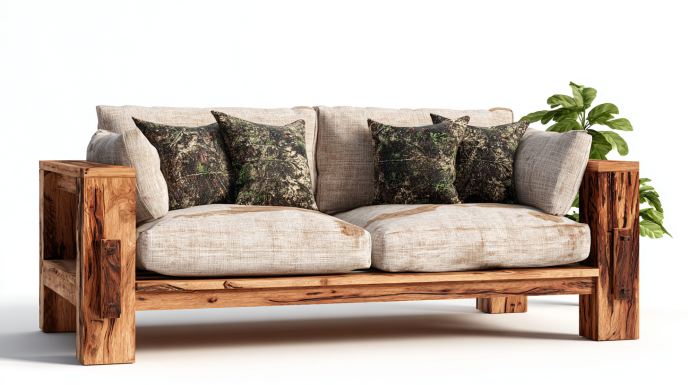
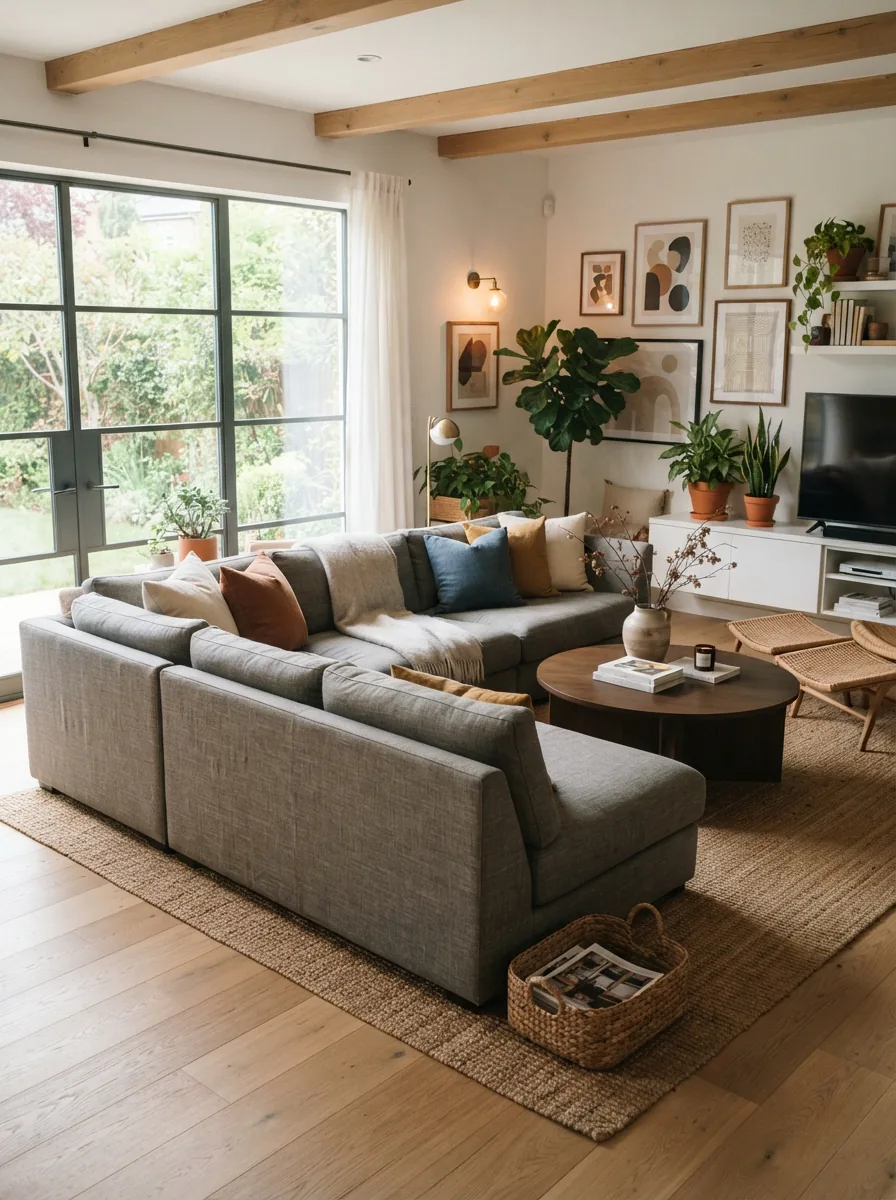
Brief Description: The Sabai Essential Sectional is a B Corp-certified, American-made modular sectional constructed with FSC-certified hardwood frames, CertiPUR-US certified foam, and recycled velvet upholstery sourced from upcycled polyester. The design is completely free of toxic flame retardants and off-gassing compounds, making it one of the cleanest indoor air quality options in its price class. Fully removable and machine-washable covers make it exceptionally practical for households with children and pets. Modular configurations seat up to seven people, with customizable leg styles in wood or metal finishes. Sabai’s closed-loop repair and buyback program allows customers to replace individual components rather than discarding the full unit, substantially reducing long-term furniture waste.
Editor Rating: ⭐ 4.8 / 5
Price Range: $1,695 – $5,795
2. Medley Rio Sofa in Natural Latex

Brief Description: The Medley Rio is handcrafted in the USA and represents one of the most specification-intensive natural latex sofas available to residential buyers. Each seat cushion is built around a core of certified organic natural latex foam — tapped directly from rubber trees and biodegradable at end of life — then wrapped in a lofted wool fiber envelope for down-like softness and superior shape retention. The kiln-dried hardwood frame carries a lifetime structural warranty, and the cushion fill is documented to maintain its spring-back performance for 20+ years of regular use. The Rio carries CertiPUR-US, GREENGUARD, GOTS, and OEKO-TEX certifications across its components. Customizable in fabric, dimensions, and leg finish.
Editor Rating: ⭐ 4.9 / 5
Price Range: $3,095 – $4,595
3. Crate & Barrel Retreat Sofa
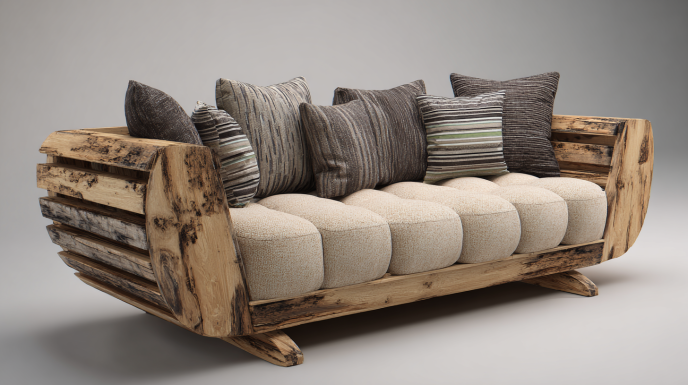
Brief Description: The Retreat Sofa is Crate & Barrel’s bestselling FSC-certified sustainable sofa, available across a wide size range from 78 to 103 inches. Built on responsibly sourced hardwood frames with upholstery options that prioritize eco-conscious manufacturing, select Retreat configurations also carry GREENGUARD Gold Certification — one of the most stringent indoor air quality standards available, originally developed for sensitive institutional environments. Available in both standard sofa and sectional configurations, including reversible chaise lounge variants. The Retreat line represents a well-documented entry point into certified sustainable furniture for buyers seeking a balance of accessibility, design range, and verified material standards.
Editor Rating: ⭐ 4.7 / 5
Price Range: $2,099 – $3,498
4. 7th Avenue Cloud Sectional
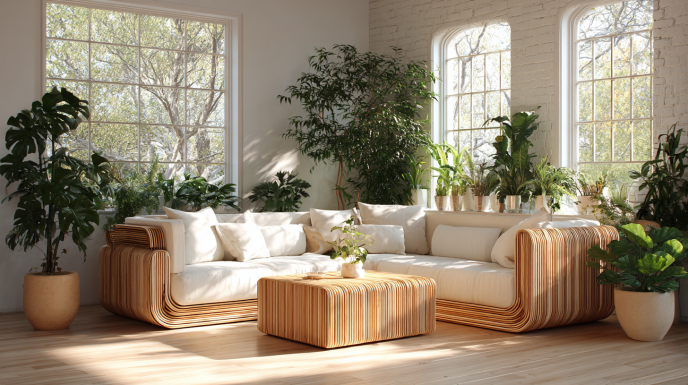
Brief Description: The 7th Avenue Cloud Sectional is built on FSC-certified solid hardwood frames — explicitly no composite wood, no MDF — reinforced with sustainable steel joinery for exceptional structural longevity. Cushion fill uses a vegan, cruelty-free down alternative that is OEKO-TEX certified, hypoallergenic, and free of any animal-derived inputs. Cover fabrics feature a PFAS-free water-repellent DWR coating, replacing older fluorinated treatments that bioaccumulate in ecosystems and human tissue. Covers are fully removable and machine washable. Low-VOC finishes are applied throughout. The modular architecture allows flexible reconfiguration between L-shape, U-shape, and open-end layouts as household needs evolve.
Editor Rating: ⭐ 4.8 / 5
Price Range: $2,950 – $10,400+
5. The Futon Shop Organic Modular Sofa
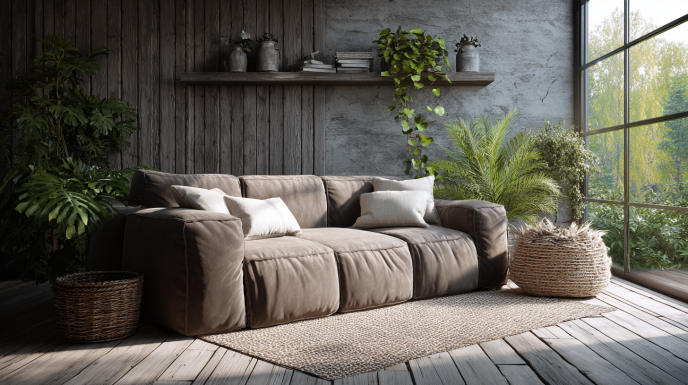
Brief Description: Handcrafted in California and sold exclusively through The Futon Shop, the Organic Modular Sofa is built entirely without petrochemicals or polyurethane foam. Fill materials include certified organic wool, natural or organic latex, and coconut coir — three of the most functionally sound and environmentally responsible cushion fill materials available. Zero VOCs throughout. Available as a ready-made option that ships in 2–3 days or as a fully custom order in any fabric color. For buyers requiring a fully vegan configuration, wool is replaced with PLA fiber derived from potato starch, delivering comparable resilience without animal inputs or synthetic chemical compounds. The modular piece structure supports mix-and-match room layouts and future reconfiguration.
Editor Rating: ⭐ 4.6 / 5
Price Range: $1,200 – $4,000+ (varies by configuration)
What Actually Makes a Sofa “Eco-Friendly”?
The term eco-friendly is applied with frustrating looseness across the furniture retail industry. Understanding the specific structural, material, and certification standards that distinguish genuinely sustainable sofas from marketing claims is essential before making a purchase of this magnitude.
Frame Construction: The Foundation of Longevity
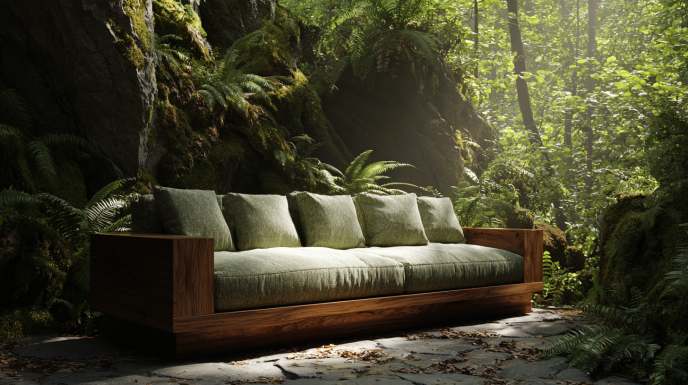
The frame determines the structural lifespan of any sofa, and in the context of sustainable furniture, FSC-certified or PEFC-certified hardwood is the verified benchmark. The FSC (Forest Stewardship Council) certification confirms that wood was harvested from responsibly managed forests where biodiversity is maintained, ecosystems are protected, and community rights are respected throughout the supply chain. Brands including Medley, Sabai, Crate & Barrel, and 7th Avenue all use FSC-certified frames across their sustainable collections.
Kiln-dried hardwood is the specific processing standard that maximizes longevity. The kiln-drying process removes residual moisture from lumber, preventing warping, cracking, and joint loosening over time. A sofa built on a kiln-dried solid hardwood frame will hold its structural integrity far longer than one built with MDF, particleboard, or low-grade plywood — categories of engineered wood that commonly use formaldehyde-based adhesives and degrade significantly faster under load.
Cushion Fill: The Most Critical Material Variable
The cushion is where the majority of the environmental and health risk in a conventional sofa originates. Standard polyurethane foam is petroleum-derived, contributes to global CO₂ emissions at scale during manufacturing, and off-gasses VOCs — including formaldehyde, benzene, and acetaldehyde — into your indoor environment. According to research cited by Medley, synthetic furniture foam accounts for approximately 105 million tons of annual CO₂ emissions globally, a figure that underscores the systemic scale of this material problem.
The two leading eco-certified alternatives are natural latex foam and wool fiber wrap. Natural latex is harvested by tapping rubber trees, making it a renewable, biodegradable raw material. When certified to the GOLS standard, it guarantees that no synthetic chemicals were introduced during cultivation or processing. The mechanical properties of natural latex are exceptional: it provides high spring-back response that maintains cushion shape for over two decades of regular use, while also being inherently resistant to dust mites and mold. Wool, used as a cushion-wrapping layer, offers natural moisture wicking, thermal regulation, and — critically — natural fire resistance without any added chemical treatment. Wool’s inherent flammability characteristics allow it to meet domestic fire safety standards independently, eliminating the need for the halogenated flame retardant compounds commonly applied to conventional sofa foam.
Coconut coir — compressed coconut husk fiber — is a third material used as a base support layer in products like The Futon Shop’s organic line. It is entirely natural, biodegradable, and provides breathable, firm support beneath latex layers.
Upholstery Fabric: The Surface-Level Health Interface
The fabric in direct contact with users daily should meet the same rigorous standards as the fill inside the cushion. OEKO-TEX Standard 100 independently tests for the presence of over 100 regulated harmful substances in every layer of a fabric, including heavy metals, pesticide residues, allergen-activating compounds, and formaldehyde. It is one of the most globally recognized and trusted textile safety certifications available to consumers. GOTS (Global Organic Textile Standard) extends this further by certifying that organic fibers were used and that ecological and social criteria were met across the full production chain.
For water-resistance treatment, the transition away from PFAS (per- and polyfluoroalkyl substances) is an important specification to check. Brands like Anabei and 7th Avenue now use PFC-free DWR (Durable Water Repellent) coatings that deliver effective stain and water resistance without fluorinated compounds, which have been identified as persistent environmental contaminants that accumulate in biological systems.
Key Certifications: What to Verify Before Buying
When evaluating an eco-friendly sustainable sofa, these certifications represent the most meaningful third-party verification available:
FSC (Forest Stewardship Council) confirms responsible sourcing of wood in frame construction. GREENGUARD Gold tests VOC emissions against the strictest indoor air quality thresholds, originally established for schools and healthcare environments. CertiPUR-US certifies foam free of ozone depleters, heavy metals, formaldehyde, phthalates, and prohibited flame retardants. GOLS (Global Organic Latex Standard) certifies organic natural latex at the source. GOTS covers organic fiber upholstery across the full supply chain. OEKO-TEX Standard 100 certifies fabric safety across over 100 regulated substances. Cradle to Cradle evaluates full product lifecycle performance including material reutilization and renewable energy use. B Corp Certification, held by manufacturers like Sabai, reflects company-wide verified environmental and social performance.
The Health Case for Non-Toxic Seating
The health argument for choosing a chemical-free, certified organic sofa is well-documented in environmental health research. Conventional sofas commonly introduce added flame retardants — including halogenated compounds associated with developmental neurotoxicity and thyroid disruption — along with formaldehyde from adhesives and engineered wood, and chronic low-level VOC exposure from petroleum foam off-gassing. These compounds do not dissipate quickly; they can persist in household air for months at elevated concentrations and at lower levels for considerably longer.
A sofa built with organic latex, ethically sourced wool, and FSC-certified solid hardwood introduces none of these compounds. For households with infants, young children, pregnant individuals, or occupants with respiratory sensitivities including asthma or chemical sensitivity disorders, the switch to a GREENGUARD Gold or OEKO-TEX certified sofa represents one of the most impactful indoor air quality improvements available without any structural renovation.
Durability and Long-Term Material Performance
One of the strongest functional arguments for sustainable sofas is their superior long-term durability relative to conventional alternatives. Natural latex cushions are documented to maintain spring-back performance exceeding 20 years. Kiln-dried hardwood frames, backed by lifetime warranties at brands like Medley, outlast MDF or particleboard constructions by decades. Wool cushion wrap holds its loft better than polyester fill, which compresses irreversibly within years of regular use.
Modular designs extend functional product lifespan by allowing individual components to be replaced, reconfigured, or repaired rather than triggering full-unit replacement. Sabai’s closed-loop buyback initiative and Home Reserve’s component replacement system are industry-leading examples of how sustainable furniture brands are engineering against the disposability model that generates enormous furniture landfill waste annually.
Final Verdict
The specification data is unambiguous: an eco-friendly sustainable sofa is not a compromise — it is a materially superior product. Organic latex outperforms petroleum foam in shape retention, hypoallergenicity, and environmental impact. Wool outperforms polyester fill in durability, moisture management, and fire resistance. FSC-certified kiln-dried hardwood outperforms engineered wood in structural longevity. And GREENGUARD Gold or OEKO-TEX certification provides documented assurance that your sofa will not degrade the air quality in the spaces where your family spends the most time.
The five products reviewed above — Sabai, Medley Rio, the Crate & Barrel Retreat, 7th Avenue Cloud Sectional, and The Futon Shop Organic Modular Sofa — represent the best available options across price tiers, certification depth, and design flexibility. Whether the priority is entry-level accessibility, maximum organic certification, modular reconfigurability, or vegan material compliance, the right sustainable sofa exists at every serious buyer’s budget. The performance case, the health case, and the environmental case all point in the same direction. The only remaining variable is which specification set best matches your household’s needs.