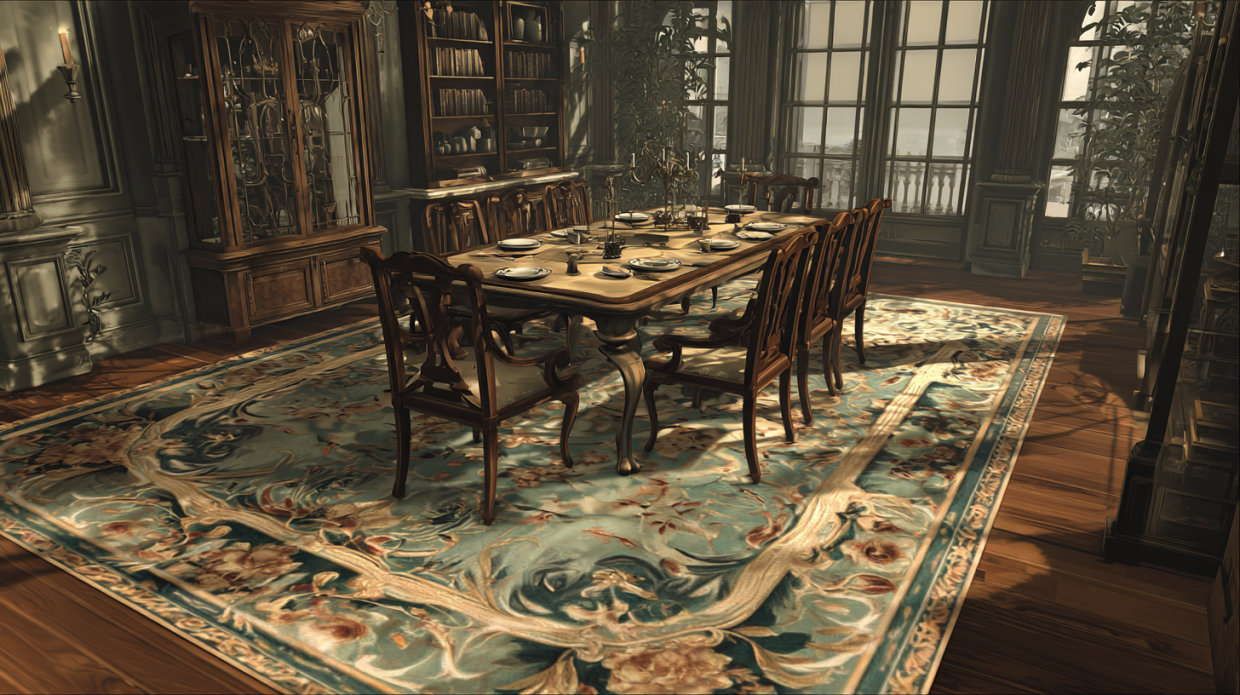
The dining room is one of the most functionally demanding spaces in any home. It absorbs relentless foot traffic, endures the mechanical abrasion of chair legs scraping across its surface dozens of times daily, confronts spilled liquids and dropped food, and simultaneously serves as the visual centerpiece for both casual family meals and formal entertaining occasions. Within this complex, high-performance environment, the large dining room area rug functions not merely as a decorative accessory but as a critical architectural and functional component of the overall room design. A properly proportioned large area rug anchors the dining table visually, defines the boundaries of the dining zone within open-plan living spaces, provides underfoot comfort during prolonged meals, and protects the underlying hard floor from the mechanical stress of repeated chair movement. Research in interior design ergonomics consistently demonstrates that rugs measuring at least 8×10 feet represent the minimum effective threshold for standard dining configurations, while the most clinically recommended size for a table seating six to eight occupants is 9×12 feet — large enough to allow chairs to remain fully on the rug surface even when pulled back from the table, which eliminates both the tripping hazard and the floor-protection failure that occurs when a rug is undersized. This guide delivers an authoritative, evidence-based examination of large dining room area rugs — from selection criteria and material science to maintenance protocols and design integration strategies. Whether you are outfitting a formal dining space, a casual family dining area, or a multi-functional open-plan room, the expert guidance here is calibrated to help you make a precisely informed purchasing decision.
Top 5 Most Popular Large Dining Room Area Rugs
The following five products represent the highest-rated, most widely purchased options currently available in the large dining room area rug category. Each selection has been evaluated based on consumer rating data, price-to-performance ratio, design versatility, and documented durability in dining room applications.
1. FLOR Rush Street
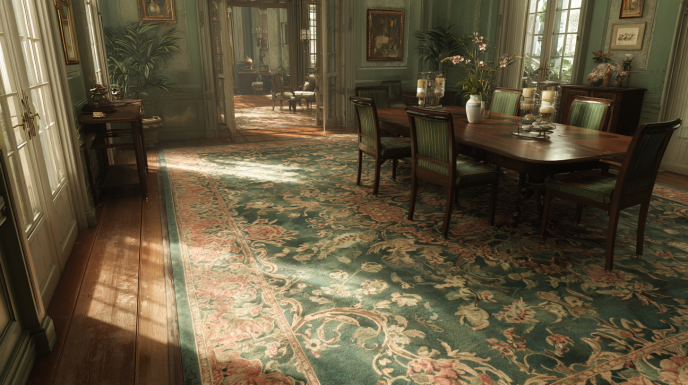
One of the most versatile and consistently top-rated entries in the modular carpet-tile rug category, the FLOR Rush Street is available in an extraordinary range of over 56 color and pattern combinations, making it one of the most customizable large dining room rugs on the market. Its modular carpet-tile construction allows homeowners to assemble a rug in virtually any custom dimension — a critical advantage for dining rooms with non-standard table sizes or irregular floor plans. The low-pile surface is particularly practical in dining environments, as it resists the accumulation of food debris within pile fibers and facilitates smooth, resistance-free chair movement. The tile-based architecture also means that individual tiles can be removed, cleaned independently, and replaced without disturbing the surrounding rug structure — an operational advantage of measurable value in high-spill environments. For households seeking a high-customization, low-maintenance solution, Rush Street stands as the definitive reference product in its category.
- Rating: ⭐⭐⭐⭐⭐ (4.8/5)
- Price Range: $11.99 – $15.00 per tile
2. FLOR California Dreaming
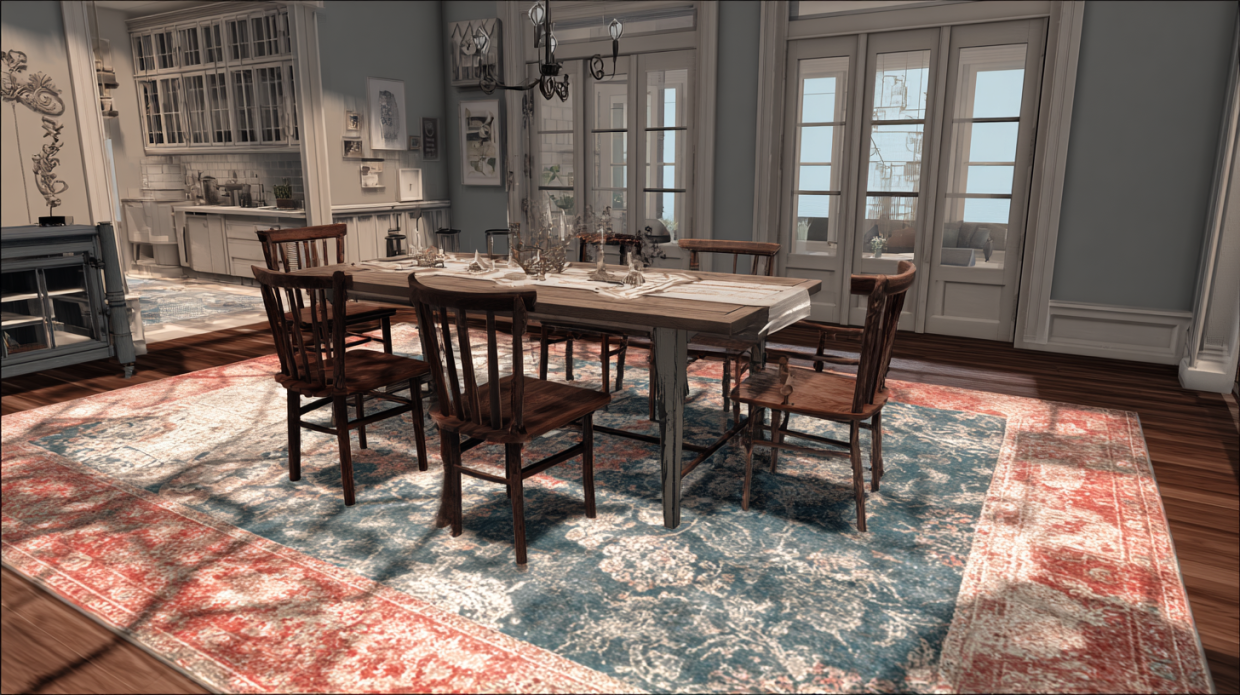
The FLOR California Dreaming rug brings a warm, sun-drenched aesthetic to the dining space without sacrificing structural performance. Its medium-pile height delivers a tactile softness underfoot that is particularly appreciated in dining rooms where occupants frequently dine barefoot or in socks. The design features a nuanced, tonal pattern that reads as visually sophisticated in formal dining rooms while remaining relaxed enough for casual kitchen-adjacent dining spaces. Available in a curated color range spanning neutral sand tones through deeper terracotta, this rug integrates cleanly into warm-toned interior design schemes — a palette that professional hospitality designers consistently associate with appetite stimulation and relaxed social interaction. The medium pile also provides a meaningful level of acoustic dampening, reducing the impact noise that is particularly prevalent in hard-floored dining rooms during active mealtimes.
- Rating: ⭐⭐⭐⭐½ (4.6/5)
- Price Range: $25.00 – $30.00 per tile
3. FLOR Chasing Pavement
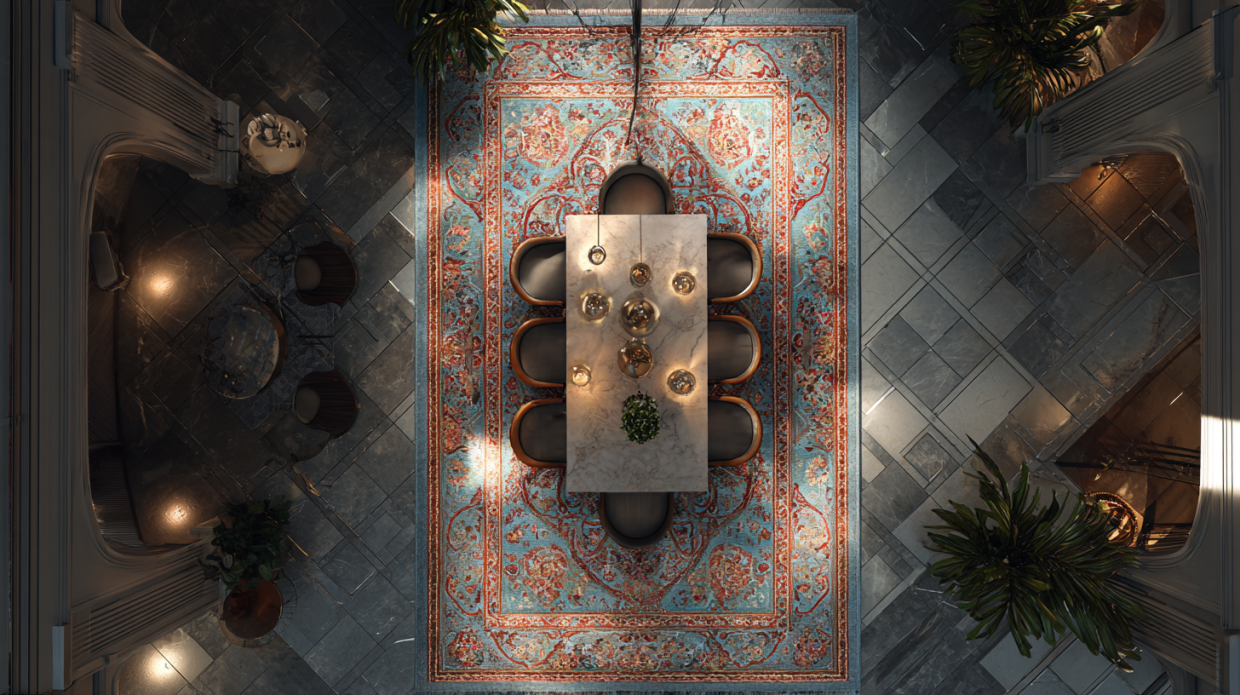
For dining rooms requiring a rug of exceptional visual discipline and geometric clarity, the FLOR Chasing Pavement delivers a high-contrast pattern with striking graphic precision. Its bold linear design creates a powerful visual anchor beneath the dining table that communicates intentionality and design confidence. The monolithic installation method produces a seamless, uninterrupted visual surface that reads as a single cohesive large area rug rather than assembled tiles — an important consideration in formal or contemporary dining spaces where visual coherence is paramount. The medium-pile construction balances aesthetic refinement with practical durability, withstanding the demands of daily dining use without visible wear degradation over time. Design professionals consistently cite Chasing Pavement as a top selection for modern dining rooms in which geometric visual architecture is a primary design directive.
- Rating: ⭐⭐⭐⭐½ (4.5/5)
- Price Range: $32.00 per tile
4. Ruggable Classic Solid Washable Rug
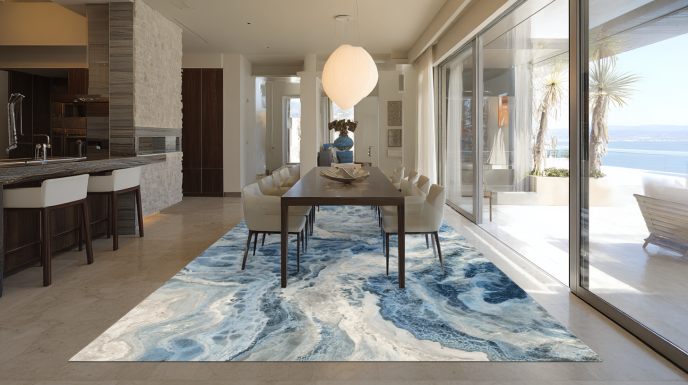
Ruggable’s signature two-piece washable rug system has established a clinical benchmark in the machine-washable large dining room rug category. The Classic Solid Washable Rug — available in large configurations up to 9×12 feet and beyond — employs a rug cover and rug pad system that allows the top layer to be detached and laundered in a standard home washing machine. This machine-washable construction is of particular clinical significance in dining environments, where liquid spills, grease residue, and food particulates represent persistent contamination challenges that spot-cleaning alone cannot fully resolve. The rug’s low-profile design ensures that chair legs do not catch on pile fibers, and the non-slip rug pad provides consistent floor-surface protection. Available across a broad spectrum of solid neutrals and earthy tones, it integrates into virtually any dining room design aesthetic with minimal visual friction.
- Rating: ⭐⭐⭐⭐½ (4.6/5)
- Price Range: $199 – $399 for large and oversized configurations
5. FLOR Desert Martini
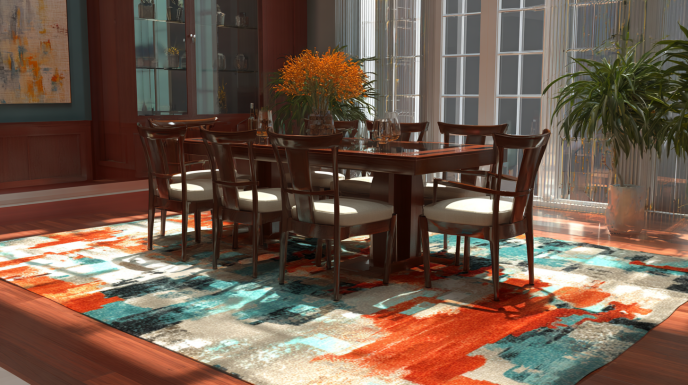
The FLOR Desert Martini occupies the premium tier of the FLOR dining room rug assortment. Its sophisticated abstract pattern draws from mid-century and art deco visual traditions, making it one of the most design-forward options available in the large dining room rug category. At $36.00 per tile, it is priced to reflect the level of visual complexity and material refinement it delivers. The rug is particularly well-suited for formal dining rooms in which the rug itself is intended to serve as the primary decorative statement — a design philosophy endorsed by professional interior designers who advocate for investing in high-visual-impact foundational pieces rather than distributing the design budget across multiple smaller accessories. Multiple colorways allow integration into both cool and warm dining room palettes, extending its versatility across a wide range of design contexts.
- Rating: ⭐⭐⭐⭐⭐ (4.7/5)
- Price Range: $36.00 per tile
Why Size Is the Single Most Consequential Variable
In the clinical analysis of large dining room area rug performance, size precision is the most consequential purchasing variable — more determinative of functional success than material selection, color choice, or pile height. An undersized rug in a dining room creates a predictable and well-documented sequence of failures: chair legs transition from rug to bare floor during normal seating and rising motions, generating instability, producing impact noise, and delivering a discontinuous tactile experience that signals poor spatial planning to observant guests. More critically, an undersized rug fails to fulfill its primary protective function, leaving the floor surface beneath chair-leg contact points fully exposed to scratching and abrasion.
The industry-standard sizing protocol for large dining room area rugs is derived from a straightforward ergonomic principle: when a dining chair is fully occupied and positioned for comfortable eating, the rear legs of the chair must remain entirely on the rug surface. For a standard 36-inch-wide dining table with chairs extending outward during use, this requires the rug to extend a minimum of 24 to 30 inches beyond each end of the table and at least 18 to 24 inches beyond each long side. Applied to a common 60×36-inch dining table, this calculation yields a minimum rug dimension of approximately 9×8 feet, which rounds to a 9×12 foot rug as the most practical standard selection for tables seating six to eight occupants.
For larger dining configurations — including 8-person tables, farmhouse-style tables measuring 84 inches or longer, or dining areas within open-concept great rooms — 10×14 foot rugs or larger are the clinically appropriate selection. In these configurations, the rug must simultaneously protect the floor beneath the dining zone and function as a visual territory marker, delineating the dining space as a distinct spatial unit within the larger open-plan environment. The modular tile systems offered by FLOR are particularly well-positioned to address these non-standard sizing demands, as tiles can be assembled into any configuration without the dimensional constraints imposed by traditional woven rug manufacturing.
Material Selection: A Functional Analysis
The material composition of a large dining room area rug determines its performance across four primary dimensions: durability, cleanability, comfort underfoot, and acoustic performance. Each material category carries a distinct profile of strengths and limitations that must be evaluated against the specific functional demands of the individual dining environment.
Polypropylene and synthetic fiber rugs represent the dominant material choice in dining room applications for well-documented reasons. Polypropylene fibers are inherently stain-resistant at the molecular level, do not absorb moisture, and demonstrate high resistance to fading under both natural and artificial light exposure. Their dimensional stability under mechanical load makes them resistant to pile crushing from chair legs — a significant long-term performance advantage in dining environments. Polypropylene is also the primary substrate material in machine-washable rug systems, where the rug cover must survive repeated wash cycles without structural degradation or dimensional distortion.
Nylon fiber rugs offer superior mechanical resilience compared to polypropylene, with a demonstrably higher resistance to pile crushing and a longer effective functional lifespan under heavy-use conditions. Nylon accepts dye more uniformly than most synthetic alternatives, which produces richer color saturation and more precise pattern reproduction — a meaningful aesthetic advantage in design-forward dining rooms. For dining spaces that host frequent formal entertaining, nylon construction is frequently recommended by professional designers as the optimal equilibrium between aesthetic quality and functional durability.
Wool rugs, while representing the premium natural-fiber option, present a more nuanced performance profile in dining environments. Wool’s natural lanolin content provides a baseline level of inherent stain resistance, and its dense pile construction delivers exceptional acoustic dampening — a measurably significant benefit in hard-surfaced dining rooms where sound reverberation can degrade the quality of conversation and the overall dining experience. However, wool requires professional cleaning for liquid spills unless the rug has been treated with a hydrophobic protective coating, and it carries a substantially higher replacement cost than synthetic alternatives. For formal dining rooms where aesthetic refinement is the dominant priority and the frequency of heavy use is low, wool remains a clinically defensible choice supported by centuries of functional precedent.
Jute and natural fiber rugs — including sisal-inspired options in collections such as FLOR’s Jute Box — offer a highly textural, organic aesthetic that has maintained sustained consumer popularity in casual dining environments and kitchen-adjacent dining areas. Their primary functional limitation in dining applications, however, is their hydrophilicity: natural cellulosic fibers absorb moisture readily, which creates a documented risk of mold and mildew formation if liquid spills are not remediated immediately and thoroughly. For dining rooms occupied by young children or pets, or in households where the dining area is used for multi-purpose activities, natural fiber rugs carry a meaningful and ongoing maintenance burden that prospective buyers should systematically evaluate before committing to purchase.
Design Integration: Proportional and Aesthetic Principles
The selection of a large dining room area rug involves not only functional but also proportional and aesthetic considerations grounded in established interior design principles. A rug that is technically correct in size but aesthetically discordant with the room’s design language will undermine the cohesive visual coherence of the space, regardless of how well it performs functionally.
The principle of visual grounding dictates that the rug’s pattern scale should be proportional to the room’s overall dimensions and the visual mass of the furniture it anchors. In large dining rooms, small-scale repeat patterns can read as visually fragmented and fail to deliver the anchoring effect that large area rugs are designed to achieve. Larger-scale geometric or graphic patterns are consistently more effective at providing the visual weight and territorial definition required in expansive dining spaces.
Color selection in large dining room rugs warrants particular strategic attention, as the rug occupies a disproportionately significant percentage of the room’s total visible surface area. Neutral tones — including grey, ivory, warm beige, and natural linen — maintain design longevity by supporting a wide range of furniture finishes, tableware aesthetics, and seasonal décor changes. They also resist the visual fatigue that more saturated colorways can produce over extended periods of daily exposure. The FLOR dining room rug assortment reflects this empirically grounded preference, with neutral-category rugs representing the largest individual segment of their dining room product range.
From a functional standpoint, dark or multi-tonal patterns with visual complexity are diagnostically superior to solid light-colored rugs in dining environments because they are substantially more effective at visually concealing the inevitable evidence of regular food and beverage use — a practical consideration of particular significance in households with children or in dining rooms that host frequent social entertaining.
Maintenance Protocols: Preserving Long-Term Performance
The long-term functional performance of a large dining room area rug is determined as much by maintenance protocol discipline as by initial material quality. An exceptional rug maintained improperly will degrade measurably faster than a mid-range rug maintained according to scientifically sound best practices.
Routine vacuuming should be conducted at minimum twice weekly in active dining environments, with particular attention paid to the areas beneath and immediately surrounding chair positions where food particulate accumulation is most concentrated. For low-pile and medium-pile rugs, a suction-only vacuum head is recommended to avoid mechanical distortion of pile fibers. Beater-bar attachments, while effective for deep-cleaning high-pile residential carpets, can accelerate fiber degradation in the shorter pile constructions common in dining room rugs.
Immediate spill response is the single most impactful maintenance behavior available to the rug owner. The blot-and-absorb method — applying a clean, dry cloth in a firm, sustained pressing motion rather than a rubbing motion — removes liquid from the rug surface without mechanically distributing the staining compound more broadly through the pile substrate. For water-soluble stains, a dilute solution of cold water and mild dish soap applied sparingly, followed by thorough blot-drying, represents the clinically validated first-line treatment protocol. For oil-based or lipid stains, an initial application of dry baking soda assists in drawing the lipid compounds out of the fiber matrix before liquid treatment is applied.
The modular carpet-tile system offered by FLOR represents a paradigm shift in large dining room rug maintenance philosophy. Rather than treating the rug as a monolithic object requiring whole-rug professional cleaning — a process that is logistically complex, expensive, and environmentally wasteful — the FLOR system enables individual tiles in affected areas to be removed, laundered in isolation, and reinstated. This targeted, modular maintenance model is precisely calibrated to the operational reality of dining environments, where spill events are frequent but spatially localized. Tiles that sustain irrecoverable damage from staining or physical wear can be replaced individually at modest cost, without requiring disposal of the entire rug — a feature that simultaneously reduces ongoing maintenance expenditure and measurably reduces textile waste generation.
Ruggable’s two-piece architecture provides a complementary maintenance solution through a different mechanism: the removable, machine-washable rug cover enables full-surface laundering at low temperatures in a standard household washing machine. This whole-rug washing capability delivers a level of hygienic cleanliness that is unachievable through spot treatment alone, and it is particularly valued in households where allergen management, pet hygiene, or food-safety standards constitute primary functional requirements.
Sustainability Considerations
The environmental impact of large area rug production, use, and end-of-life disposal is an increasingly determinative factor in consumer purchasing decisions, and the dining room rug category has responded with measurable and documented innovation in sustainable design practice.
FLOR’s Return & Recycle program represents one of the most rigorously implemented and independently verifiable sustainability initiatives in the residential rug market. The program accepts used FLOR carpet tiles through a pre-labeled return logistics system and processes them for conversion into new rug products, closing the material loop in a manner that directly and quantifiably reduces the volume of textile waste entering landfill systems. Beyond recycling, FLOR has advanced the sustainability frontier by introducing a line of Carbon Negative Rugs — products whose full lifecycle carbon footprint, encompassing raw material extraction, manufacturing, transportation, use-phase maintenance, and end-of-life processing, results in a net negative carbon balance. This achievement positions FLOR beyond the industry standard of carbon neutrality and establishes a new performance benchmark for environmentally responsible large-format rug design.
For consumers to whom environmental accountability is a primary purchasing criterion alongside aesthetic and functional performance, selecting a large dining room area rug from a manufacturer with a documented, operational, and independently verifiable recycling or material take-back program represents the highest-impact choice currently available in the category.
Conclusion: The Architecture of an Informed Decision
The selection of a large dining room area rug is, at its most fundamental level, a decision about achieving a precise and sustainable balance between functional precision and aesthetic aspiration. The clinical evidence is unambiguous: correct sizing is non-negotiable and must be calculated from ergonomic first principles; material selection must be rigorously calibrated to the specific operational demands of the dining environment; and maintenance discipline is as determinative of long-term performance outcomes as the initial quality of the product itself.
The contemporary market offers a technically sophisticated and aesthetically diverse range of large dining room area rugs — from FLOR’s modular, infinitely customizable carpet-tile system to Ruggable’s machine-washable two-piece construction — that collectively address the full spectrum of consumer performance requirements and design preferences. The most consequential element of the purchasing decision is not which pattern or colorway to select, but rather which functional platform — modular tile-based customization, machine-washable simplicity, or premium natural-fiber construction — best aligns with the specific operational conditions and lifestyle parameters of your dining space.
Approach this decision with the analytical rigor you would apply to any significant long-term infrastructure investment in your home. Measure the space precisely, evaluate materials scientifically against your specific use conditions, and commit to a maintenance protocol appropriate to the product you select. A large dining room area rug chosen and maintained according to these principles will not merely perform its functional role — it will elevate the totality of the dining experience for years, and very likely decades, to come.